Looking for good news!

Good news is sadly scarce these days. You have to search well beyond the front few pages or posts to get away from the virus and its long tentacles, the nose-diving world economy, our neglect of the climate emergency, racial injustice, politicians lying and posturing, and the wars and famine which haven’t gone away, to find something positive, but this clip – A high street bistro that really delivers – is worth a read, if not for the facts and useful information, but for the way it’s written and underlying humour. 

Côte, a high-street bistro chain offering well-priced, good French food, have developed a range called Côte at Home. Jay Rayner, The Guardian’s restaurant critic, was expecting a delivery from Côte at Home, but at 9:30 pm it was cancelled: not a smart move to inflict on a national newspaper’s restaurant critic.  Jay recalls how he got his delivery, and that of five others, reinstated, and then praises Côte’s offering, as well as that of another home delivery company, Dishoom. Few good things have come out of this crisis, these two companies surely are two of them. I’m already checking if they deliver to our postcode area.

‘The thing is that Côte at Home is really good. Not just “good considering they’re a high-street chain”, or “not bad at the price”. It’s proper good, in the way you tell your neighbours about over the garden wall while dissing the government’s latest knuckle-dragging stupidity. The online selection is so extensive – not just ready meals but cheeses, wines and butchery – that I wondered whether a food service company was involved. Apparently not. Côte introduced a central kitchen for some of their dishes a while back and, with the additions of a few buy-ins, it all comes from there.’ Jay Rayner, The Guardian. More:

Who do I write for?

I get asked that question quite often, but I’m never able to give a precise answer.

I guess it’s anyone over eighteen who likes strong characters, personal conflict, emotional turmoil, an engrossing story that sucks you in, rolls along at a pace, and asks questions of the reader. I don’t write crime thrillers anymore, or about violence. I prefer to write about people and how they deal with life’s challenges. I draw my characters in some detail, including their looks, dress style, likes and dislikes, background, faults and weaknesses, interaction with friends and lovers – present and ex – and how they confront the real but rare situations I put them in. My stories are not about normal, uneventful lives, nor are they unlikely fantasies. They are about life changing situations and how people manage.    

I write to entertain, but ultimately, I write for myself, and find pleasure and satisfaction from doing that. I heard once a famous American author answer the question, ‘Who do you write for?’ ‘Myself,’ he retorted unequivocally. He went on to say that if he tried to please an audience, he wouldn’t be true to himself, ‘Better to write for yourself. Your readers will like or dislike your books, but you will have established your style, and readers will know what to expect. They can decide to read your books or not.’ He was highly acclaimed and successful. 

So, that’s the long answer to, Who do you write for? The short answer – myself and anyone who enjoys a gritty tale about life’s dramas. 

My new book, Otto and Frankie, will be available from September 4th in paperback and as an e-book. To pre-order the e-book go to, amazon.com, amazon.co.uk.    

Processing…
Success! You're on the list.

Still hopeful

I added a line to my twitter profile this week – still hopeful. With bad news having such great press at the moment ­– Corvid 19 and all its repercussions, crashing economies, wars, famine, racism, stabbings, shameful politicians, and more – you may well ask how I can justify that line.

Looking back to a blog post I wrote on 24th March – The sun is shining, and the world will go on (scroll down to read), –  where I believed man would find a way to halt the Coronavirus and deal with the economic devastation it caused, much progress has been made. Let’s take stock.

Vaccines normally take many years before they are available for use. Imperial College and Oxford University in the UK have their vaccines in trial now, with Imperial College making plans for the production of 2 billion shots and Oxford University saying if their trial is successful, they’ll have 4 billion shots available worldwide by this time next year. There are at least four more vaccines being developed in the world that we know about. They all may fail, but the scientists involved seem hopeful. To get to this stage in a few months is staggering and beyond all expectations.

One medicine is already available that prevents some seriously ill patients from dying. More will come.   

That world economies have been hit hard is not in doubt. But politicians in charge of their country’s economy have gone the extra mile to cushion the damage, and they’ll do more. The future will be tough, sadly unemployment numbers will rocket, but politicians and financial institutions will be forced, if necessary, to do whatever it takes to stop the world imploding.        

Racism is vile, and the racism we’ve witnessed in the last few months is almost beyond understanding. But I sense change. The movement against racism is not going to go away, it’s going to get stronger and will not stop until the scourge of racism is banished. The world has had a wakeup call and will not tolerate inaction and going backwards.  

The majority of humanity is hopeful and caring. People want to live in a safe, peaceful world.  Man’s imagination and inventive mind has brought us to where we are, and will defeat the pandemic, its associated mayhem, and produce a better world. Of that I’m hopeful. 

Frankie is not like Otto

Otto and Frankie.

Otto Georgeson and his daughter Frankie could not be more different. He’s rich, an acclaimed author, human rights activist, and lives in England. She lives in New York, just about survives from one pay cheque to the next and hasn’t seen or spoken to her father for twenty years. What follows is the beginning of the third chapter.

Frankie Georgeson

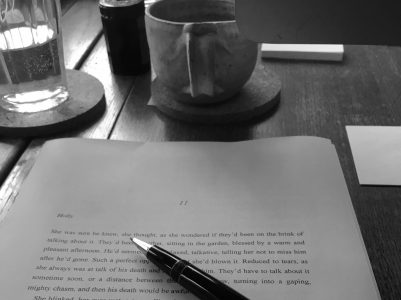
She twisted the ring through her lip a few times, checking in the mirror she’d put it in the right way. She saw in the reflection the discarded take-out food containers, the empty wine bottles lying on the stained floor, items of clothing dumped where they’d undressed with haste and passion, and a man asleep in her bed. She sighed, knowing her apartment looked the same most Sunday mornings. Sometimes there’d be ash, piled high in saucers, from the joints she and her latest pick-up had smoked. This time the guy had declined. ‘It’s high quality,’ Frankie had said, but he’d shaken his head, telling her he didn’t indulge.  

She wasn’t too bothered she could be called a slut, loosely behaved, promiscuous. ‘Men do it all the time,’ she’d told a friend, who’d heard she was sleeping with a different man nearly every Saturday night, picking them up at the club where she worked. ‘Monogamy sucks,’ she’d said, telling her friend she’d been faithful and devoted to her ex-partner for seven years. ‘Look what good it did me. He just told me one morning he was leaving me for another, gathered up his shit, and left that day.’ 

She’d been devastated, heartbroken, almost unable to function, trapped in a cage with her emotions, and started ‘multiple-dating,’ as she called it, to break with her long-standing morals. On one occasion she slept with a woman. None of her pick-ups lasted beyond a coffee in the morning, which she was fine about. Sex with no strings became her rule.  

But that morning, the man in her bed who said his name was Johnny, offered to help clear up, and when he’d done so, took her out for brunch, and walked back with her to her apartment along the shoreline of Fresh Creek Basin. He came back inside, and they watched a movie. Later she cooked an omelette and some sauté potatoes for them both, and they drank the remains of the wine from the night before. He said he had to go at 9:00 p.m., and he did, saying he’d call.  

Frankie shrugged as she’d closed the door. A great day, she thought. He’s different, unlike any man I’ve met. She shook her headBut I’ll never see him again. Of that I’m sure.

Otto and Frankie is due out on September 4th. More-

They gave me the beach back

They gave me the beach back

Some days the sandy beach stretches for about half a mile down to the distant blue sea, glistening in the sun, sitting high in a cloudless sky. Seagulls sweep and soar, at times descending at speed to a few inches from the water’s surface where they scavenge and fight with others for food. Sand dunes, at the beach’s edge, flutter and sway in the gentle breeze, seemingly wistful in their shape and form. A lone boat in full sail glides into the outer reaches of the harbour, making the only ripples in a calm sea. Sunbathers stretch out, parents build sandcastles and big fort-like constructions, dog walkers exercise their dogs, families picnic, and bathers paddle around in the shallow water, timidly inching deeper into the cool sea until they can’t delay the inevitable any longer and dive headlong into the water, splashing and swimming with vigor until their bodies adjust to a wet and chilly sensation.        

And then there are windy days when small white crests top the jagged-looking waves, and kite surfers race across the sea’s surface at speeds up to 40mph, changing direction at the end of their long stretches by jumping out of the water and twisting their board around 180° to head back from where they came, a feat they make easy but in reality breathtaking. Days when the wind is so strong that sand flurries swirl around, sometimes stinging your face. In winter these are bracing days, wrap up well days and days to prepare for watery eyes from the cold.

I love the beach at all times, summer and winter, sunny or not, and once I knew the beaches were open again, I headed off to West Wittering Beach, one of the UK’s best, and close to where I live. Familiar with the beach, I headed away from the popular area to round West Head to find an empty beach, peaceful and tranquil.

As I walked, I thought of Otto, one of the main characters in my novel, Otto and Frankie, due out in September. Here are the opening lines:    

The water is clear. Gentle waves lap on the sand, covering for a fleeting moment a broken white shell in their effervescentfoam, and I realise I’m standing on a beach, a beach I know and love, but I have no idea how I come to be in this place.It’s as though I’ve woken to find myself here, conveyed like in a sci-fi movie from one point in time to another, unaware of the journey: no sensation, no memory, no recollection of anything. A breeze on my face, a bright sun shining in the blue sky, a flat, clear sparkling sea, clean sand and emptiness – no people, no dogs, just an open space. Low tide, mud flats stretching for miles, and across the water an island, Hayling Island I think, gleaming in the still, morning light… More

‘This whole thing’s a bit of a bummer.’

That was how my 10 ½ year-old grandson from Australia described the pandemic. Quite sort of charming, I thought, compared to all the other descriptions akin to an apocalypse. The pandemic is grim, the world, especially the UK, should have been better prepared, but we’ll come through it, and the world will recover, and if we’re smart, it’ll be a better place. 

For climate deniers it poses a dilemma, finally trashing their false propaganda that man has not caused climate change. Why are the skies brighter? Why has environmental pollution fallen to levels not experienced for fifty years, and why does the air feel cleaner? Surely, it’s not because there are no polluting planes in the air or cars on the road?  

To have a world without planes and motor vehicles is not feasible, but we can learn, and stop polluting the world so much. A forty percent reduction in flying and use of motor vehicles, not immediately but over five to ten years, would make a significant contribution to reaching our goal of zero carbon emissions by 2030.

Building a green economy, and by that, I mean developing a product, practice, and service that moves us away from a fossil-fuel driven economy to an environmentally friendly one will need investment and people. It’s investing in new jobs and a greener, sustainable future.   

Has the NHS reached its zenith? The whole nation applauds it and the people who work within it every Thursday. And rightly so. Sadly, it’s taken a pandemic where thousands have died to make politicians realise that never again can the NHS be allowed to be under resourced. It has reached its zenith at this time, dealing with the pandemic with devotion, professionalism, grit, and love. But resourced properly, the best is yet to come.     

And the same goes for all other key sectors and those that work within them. They’ve been under resourced and under rewarded, and that needs to be rectified as well. 

By being smart and empathetic to these needs we’ll come out of this crisis to a better, fairer, greener world. 

Introducing Otto

Otto Georgeson is one of the two main characters in my new book, Otto and Frankie. He’s fifty-five, an acclaimed author, a human-rights activist, and a much loved and respected man. He’s married to Holly and has two twin sons. Over his writing career, his books have sold well, received many brilliant reviews, and he’s won the Booker prize twice. Two of his books have been adapted for the big screen. But after his last book, he tired of writing and wanted to give something back. 

He put it like this, ‘I’d stopped writing novels a few years back, and after seeing the complete dereliction of care, compassion, and responsibility from the world’s leaders for the millions of refugees seeking sanctuary, I decided to take up their cause. I’d found my so-called status as a best-selling author useful: it opened doors. I’d lobby the world’s leaders, threatening to go public if they didn’t agree to help. Some did help, some said maybe, and others refused. I didn’t go public on them, but believed I’d made progress. Some lives would be saved.’

The day he found out his cancer had returned, and he had three months to live, he learned that Holly had been having an affair with the wife of his best friend. Shocked, distraught, and saddened, he decides to ignore Holly’s behaviour, focus on his work for refugees, and do whatever he can to find his long-lost daughter, Frankie.

More about Otto, Frankie and the other characters later. Otto and Frankie is out in September. 

Filling time

Who doesn’t find these times difficult? No one I know. But regardless of the virus, these few months were going to be an in-between time for me anyway. I finished a book last year, we went to Australia in January and early February, and when we returned, I’d planned to set about catching up on things I’d put off before, leaving them until I’d completed the book. Media pressure telling us to keep busy, motivated me to clear up my unattended tasks in record time, and with my new book, Otto and Frankie, not due to be published until September, I had to think about what I’d do next.

Although there was plenty of tidying up from winter, and spring/summer preparation to do in the garden, I was kind of relieved when an old rose arbour showed serious signs of imminent collapse. This was an immediate danger. The arbour roof was tiled, and should it have collapsed, which I was sure it would do at any moment, it would have crashed to the ground, smashing the stone path and crushing all the new green shoots in the nearby border – let alone slicing my wife’s or my or both our heads open should we have been close by at the time of its self-demolition. There was nothing for it but to take it down. The morning after I’d discovered its decline, relieved it hadn’t fallen down in the night, my wife and I started to take it apart. Apart from the fear of being buried under it, should it break away from its last remaining supports, we knew, in the current circumstances, we wouldn’t have been welcomed at A&E. We completed it without any damage to the garden and us, although until the tips reopen, its dismembered parts are stacked out of site.

I thought about starting on a new book but binned the idea quite soon after – I had no idea what I’d write about and found concentration hard in these troubled times. In the hope I’d find inspiration for a short story, I started revisiting my past writings. I found a small piece, no more than 600 to 700 words, that I’d written some years back for a local publication. It was about a man who found his lost father, and it inspired me to write The parents I did not meet

My version of Paul Simon’s classic song 50 ways to leave your lover, changed to 50 ways to stay in lockdown follows this post.

I’ll be posting more about Otto and Frankie, due out in September, later. In the meantime, follow the link.  

50 ways to stay in lockdown

The lyrics for Paul Simon’s iconic 70s song, Fifty ways to leave your lover, with a few changes relevant to the strange times we’re living in. 

50 ways to stay in lockdown

“The problem is all inside your head”, she said to me
“The answer is easy if you take it logically
I’d like to help you in your struggle to stay home
There must be fifty ways to stay in lockdown”

She said, “it’s really not my habit to intrude
Furthermore, I hope my meaning won’t be lost or misconstrued
But I’ll repeat myself at the risk of being crude
There must be fifty ways to stay in lockdown
Fifty ways to stay in lockdown”

You just bolt the door, Jack
Make a new plan, Stan
You do need to be coy, Roy
Just stay inside, Gus
Don’t hop on the bus 
You do need to discuss much
Just throw away the key, Lee
And you’re locked in, Bee

Ooh, slip in the back, Jack
Make a new plan, Stan
You do need to be coy, Roy
You just listen to me
Don’t hop on the bus, Gus
You don’t…

50 ways to leave your lover – Paul Simon original – 1975

“The problem is all inside your head”, she said to me
“The answer is easy if you take it logically
I’d like to help you in your struggle to be free
There must be fifty ways to leave your lover”

She said, “it’s really not my habit to intrude
Furthermore, I hope my meaning won’t be lost or misconstrued
But I’ll repeat myself at the risk of being crude
There must be fifty ways to leave your lover
Fifty ways to leave your lover”

You just slip out the back, Jack
Make a new plan, Stan
You don’t need to be coy, Roy
Just get yourself free
Hop on the bus, Gus
You don’t need to discuss much
Just drop off the key, Lee
And get yourself free

Ooh, slip out the back, Jack
Make a new plan, Stan
You don’t need to be coy, Roy
You just listen to me
Hop on the bus, Gus
You don’t…

Paul Simon

Goats take over a Welsh street.

When I saw this brilliant clip about goats roaming an empty street, devoid of cars and people, I cheered for the goats, but then thought what’s going to happen when we’re back to normal with many vehicles clogging and polluting the streets and people milling around. There have been many similar strories of wildlife moving into areas they’ve never dared venture before as a consequence of the Coranavirus lockdown, and they’ll be more.

Of course I want the lockdown to end as soon as it’s safe to do so, but at least the animals who have ventured into pastures new have had a good time. I wonder if after it’s over we’ll be more tolerant and understanding of wildlife wanting to move into what we believe are our spaces. Nature’s creeping back where mankind has resticted it. Maybe once the virus is behind us, we’ll reconsider our ravages of the natural world.

We’ll survive the Coronavirus crisis: but let’s not forget the climate crisis, and our fight to halt the planet’s destruction. Our efforts must go on, and not be pushed aside for another day.